Project objective and design context
I wanted to connect a muscle-control signal to a mechanism that could reproduce finger movement. Building on my earlier surface electromyography (sEMG) circuit, which measured electrical activity from forearm muscles, I explored how a compact actuator could generate tendon-like motion for prosthetic and wearable robotic devices. I designed a printed finger to test how a small tendon pull could create curling and return motion.
How shape-memory alloy creates movement
SMA stands for shape-memory alloy. I used thin nickel-titanium wire that contracts when heated by electrical current. Removing power lets it cool, while an opposing restoring force supports recovery. That contraction can pull a tendon like an artificial muscle. The small available movement and the time needed for heating and cooling shaped both the circuit and the mechanism design.
Connecting muscle signals to actuation
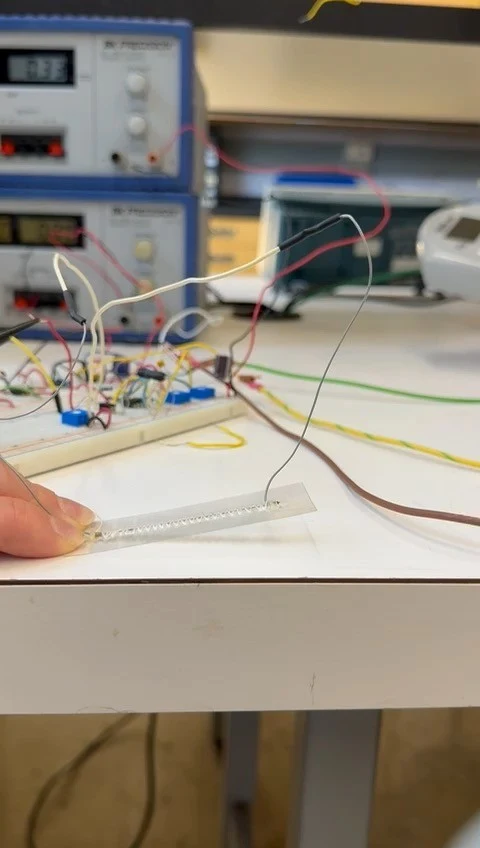
Working with my project partners, I built and tested a breadboard driver using a 555 timer oscillator, an IRLD024 MOSFET and a 1N4007 diode. Its on/off cycle gave the bendable SMA actuator time to heat and cool. I then connected the processed muscle signal from my earlier sEMG work: an INA126 instrumentation amplifier, high-pass and low-pass filters, and a precision rectifier. A forearm contraction raised the signal enough to switch current through the SMA actuator; relaxing the muscle removed the trigger.
Designing the tendon-driven mechanism
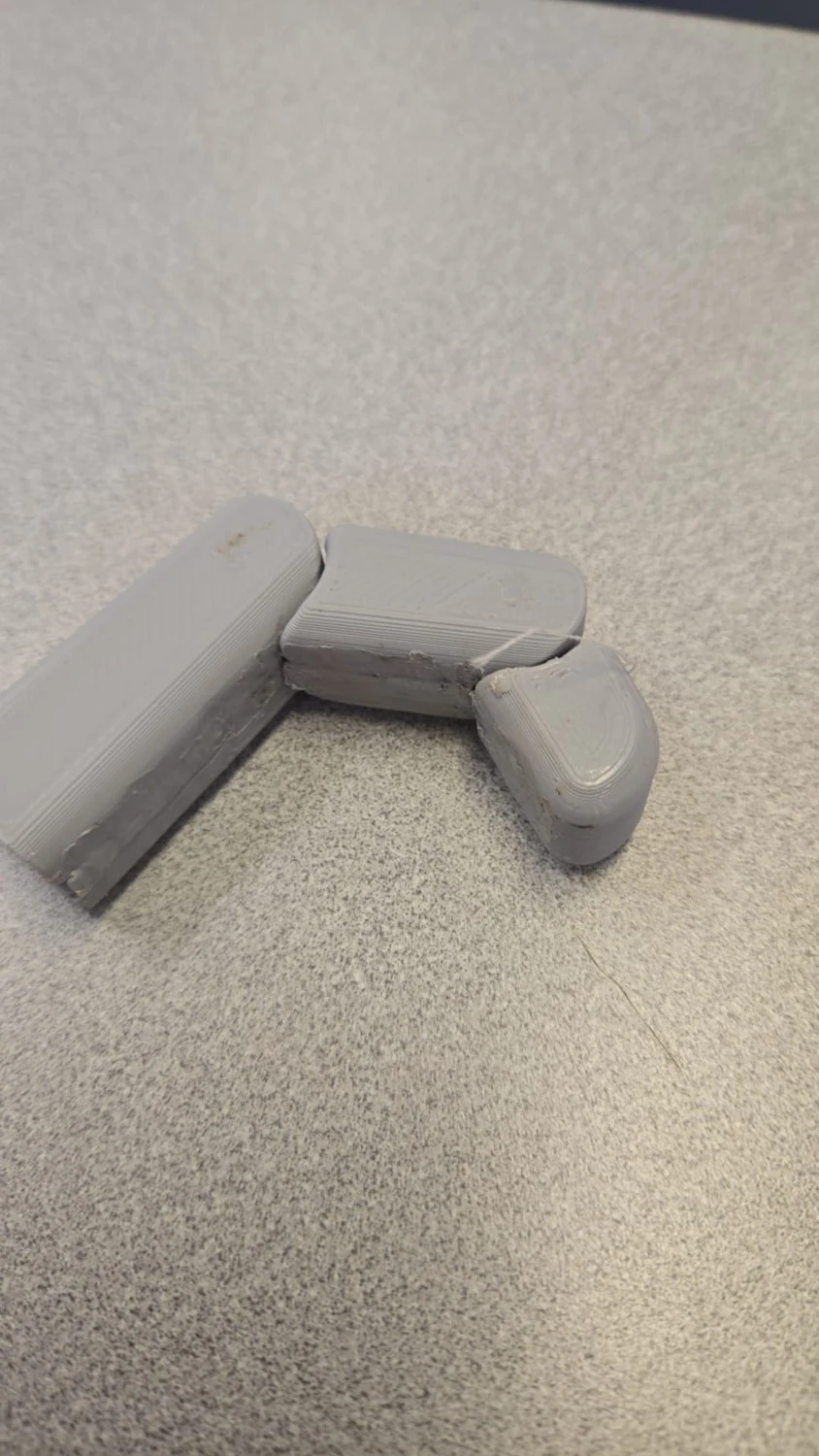
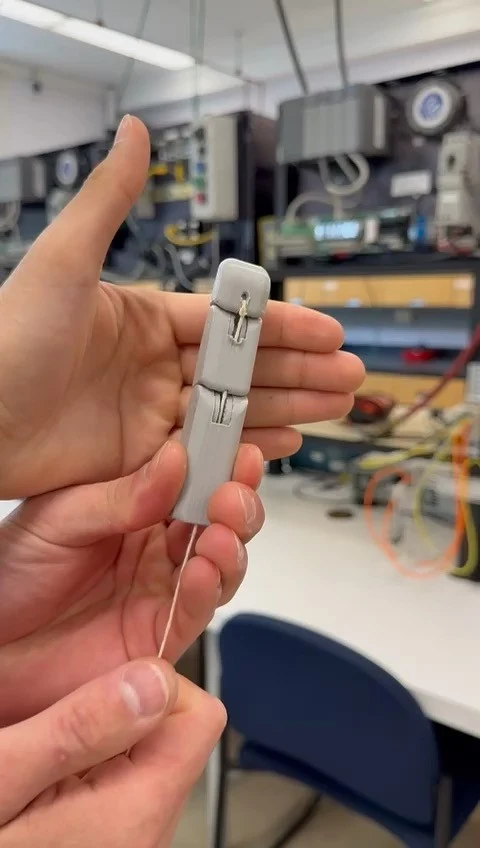
I modelled the three-link finger in SolidWorks, exported an STL file and fabricated the part by 3D printing. Its three segments represent the bones of an index finger, with thinner flexure regions at the joints and a tendon routed along the bending side. Pulling the tendon curled the finger; releasing it let the printed flexures restore a straighter shape. I used this mechanism to test how a small pull could produce useful joint motion.
What I demonstrated
I tested the electrical SMA actuator and the printed finger as separate parts of the project. In the finger video, I pull the tendon manually to simulate SMA contraction. The muscle-triggered bendable SMA actuator was tested separately. Together, the work connected biosignal conditioning, thermal actuator control and prosthetic mechanism design, and showed how cooling time and limited actuator travel constrain movement.