Full-path simulation
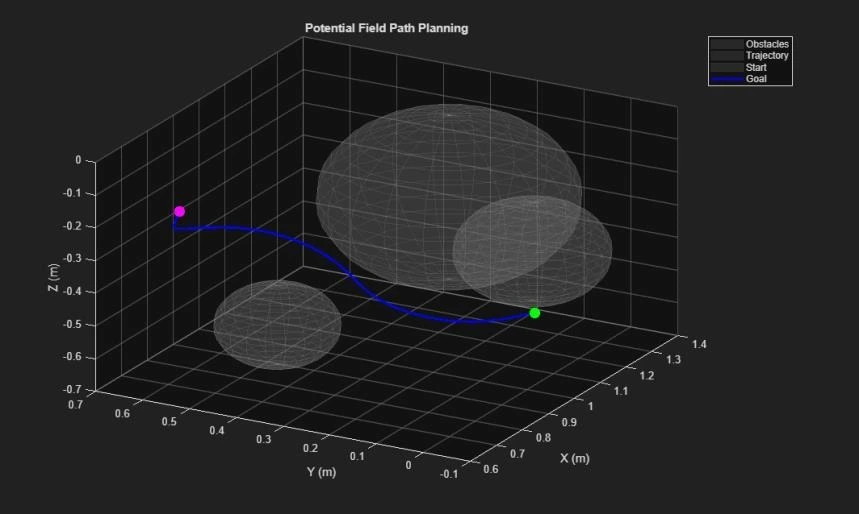
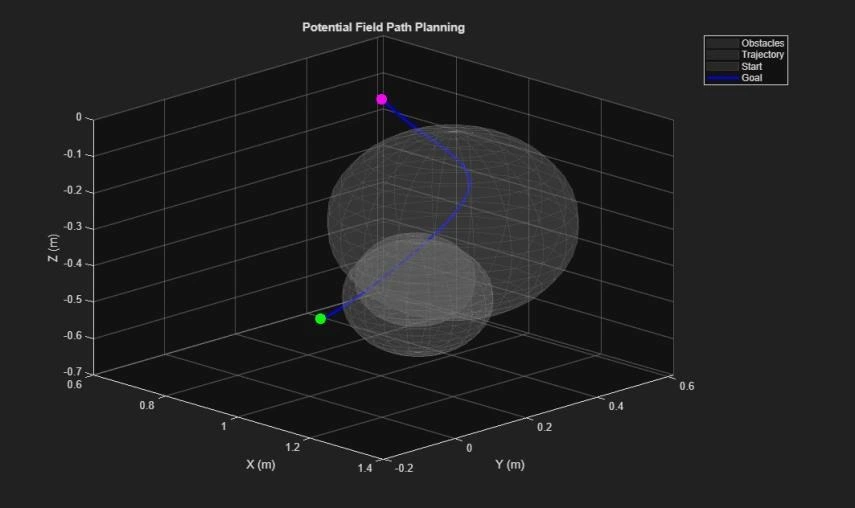
I implemented and tested the manipulator’s planned trajectory in simulation. The recorded demonstration shows the six-axis arm completing the full path, bringing the kinematic model and trajectory planning together in motion.
The task
We modeled a six-degree-of-freedom CrustCrawler arm for a bin-picking application, then planned end-effector motion around obstacles in the workspace.
The implementation
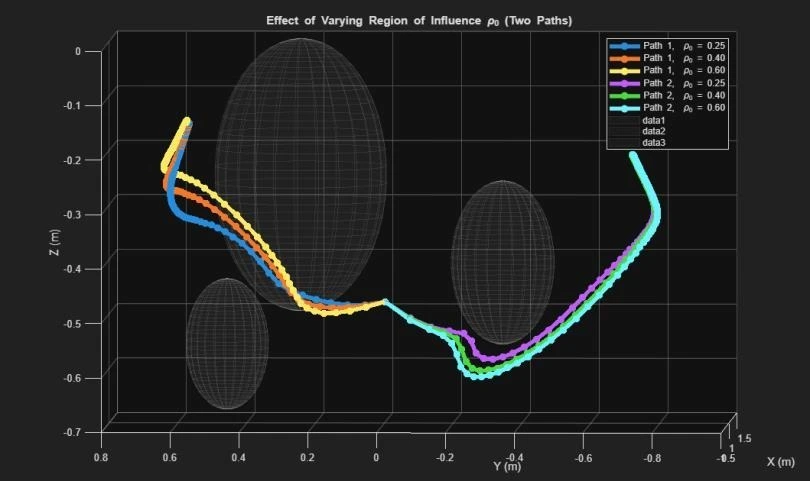
The project includes Denavit–Hartenberg forward kinematics, geometric inverse kinematics, Jacobian calculations, and potential-field planning. Parameter sweeps investigated stability and path smoothness.
Limits and related work
Representative planned paths avoided modeled spherical obstacles. The point-mass approximation and local minima limit what the simulation establishes. Related Baxter work explored PID and computed-torque control on a seven-axis robot.
Analytical modeling and planner implementation
We developed a MATLAB kinematic model for a six-axis serial manipulator, using Denavit–Hartenberg parameters, forward and inverse kinematics, and Jacobian calculations. The potential-field planner combined attraction toward the target with repulsion from spherical obstacles; a Jacobian-transpose mapping converted Cartesian motion into joint updates. Parameter sweeps examined path curvature, obstacle influence and convergence across representative tasks. Simulink formed part of the broader manipulator modeling and control coursework; the figures on this page document the kinematic and planning study.